
Arthritis affects about half of adults over 65 in the United States. Many older adults respond by moving less. Exercise research generally suggests the opposite approach is more beneficial for joint health. The challenge: choosing movements appropriate for your situation, which is where most generic fitness advice falls short for older adults with joint stiffness.
This guide covers exercises that senior fitness specialists commonly program for older adults working on joint mobility and general strength. These are general fitness movements — not treatments. Your doctor or physical therapist should always be your first stop for managing a diagnosed condition.
Why exercise helps arthritis (it's not just "use it or lose it")
Cartilage doesn't have a blood supply. Movement is how it gets nutrients — synovial fluid pushes in and out of the cartilage as joints flex. Sit still for months and that lubrication dries up. Move regularly within a comfortable range and you're literally feeding your joints.
Strength training adds a second layer. The muscles around a joint can act as shock absorbers — strong quads support the knees, strong glutes support the hips, a strong core supports the spine. Research published in journals like Arthritis Care & Research and the Cochrane Library has generally found that resistance training programs are associated with improvements in self-reported function in older adults with osteoarthritis. Individual results vary widely; talk to your doctor about what's appropriate for you.
The 7 best exercises for senior citizens with arthritis
Pick three or four. Two to three sessions per week. Build gradually.
1. Sit-to-stand (squat pattern, joint-friendly version)
From a sturdy chair, stand up and sit back down without using your hands. Aim for 8-12 reps, 2 sets. This is the single most important strength movement for adults over 50 — it directly preserves your ability to get up from chairs, toilets, and the floor. If full sit-to-stand is too hard, use the chair arms; if it's too easy, hold a light dumbbell at your chest.
2. Wall push-ups
Hands on a wall at chest height, feet 2-3 feet back. Lower your chest toward the wall, push back. 10-15 reps, 2 sets. Builds upper-body and chest strength without loading the wrists or shoulders the way floor push-ups do.
3. Heel raises
Stand near a counter for balance, rise up onto the balls of your feet, lower under control. 15-20 reps. Strengthens calves and ankles — both critical for fall prevention. Easy on the knees.
4. Hip mobility "world's greatest stretch" (modified)
From a half-kneeling position (one knee on a mat, other foot in front), gently shift forward to stretch the back hip. Hold 20-30 seconds per side. Hip mobility is often the limiting factor in arthritic knees — when hips don't move well, the knees take the brunt.
5. Cat-cow (spinal articulation)
On hands and knees, alternate between arching and rounding your spine. 8-10 slow reps. Lubricates the spine, reduces morning stiffness, and improves the kind of segmental mobility that arthritic backs often lose first.
6. Glute bridges
Lying on your back, knees bent, feet flat. Squeeze your glutes and lift your hips. Hold 2 seconds, lower. 10-15 reps, 2 sets. Strengthens the glutes and hamstrings — the muscles that take pressure off arthritic knees and lower backs.
7. Stationary bike or pool walking
15-25 minutes, 3-4 times per week. Both load the joints in a low-impact range that many older adults tolerate well. Common addition to a senior fitness program on off-days from strength training.
What to avoid (or modify)
Some movements are notorious for flaring up arthritic joints:
- Deep squats below parallel if you have knee arthritis. Stop at about chair height.
- Running on pavement with knee or hip arthritis. Trade it for the bike, elliptical, or pool.
- Heavy overhead pressing if you have shoulder arthritis. Use lighter weights with a neutral grip, or substitute incline presses.
- Long, static stretching held to the point of pain. Gentle, regular movement helps; aggressive stretching can flare an arthritic joint.
- "Pushing through" sharp pain. Mild stiffness is normal. Sharp pain or pain that lingers more than 24 hours after exercise means you went too hard.
How to start safely
Three general rules for older adults starting an exercise program with joint stiffness:
Start lighter than you think. Pain is unpredictable on days 1-7. Better to err small and add the next week than aggravate something and lose two weeks of progress.
Two-day rule. If a movement causes pain that lasts more than 48 hours, reduce the load, range, or frequency next time. It's not "no pain no gain" — it's "no extra pain by day three."
Consistency over intensity. The clients who get the best results aren't the ones training the hardest. They're the ones who showed up two or three times a week for six months. Arthritis responds to regular movement, not heroic sessions.
When to work with a Certified Senior Fitness Trainer
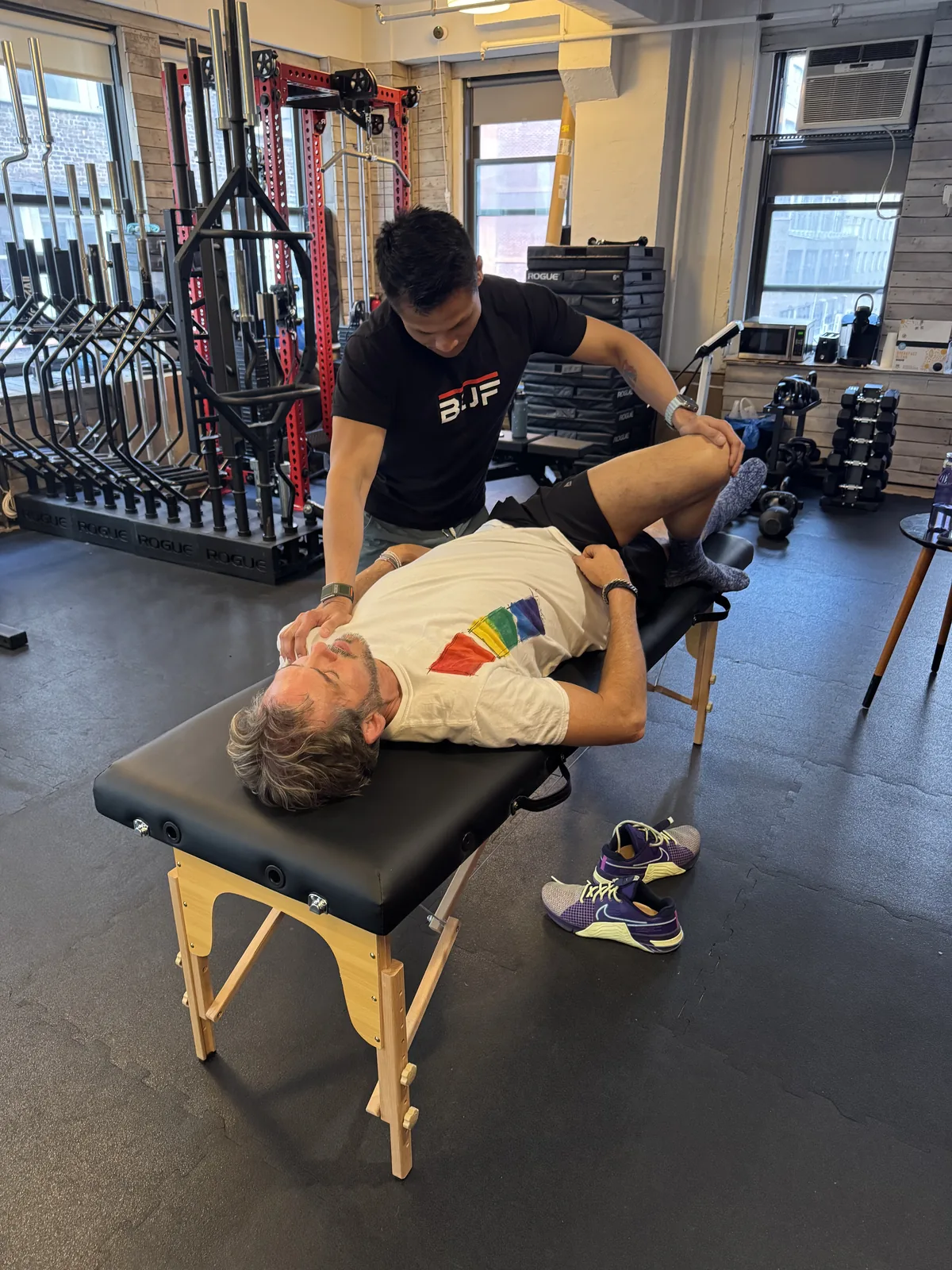
You don't need a trainer to get started — but for many older adults working on joint mobility, a few sessions with a Certified Senior Fitness Specialist can be a useful starting point. A coach can help you focus on form, modify exercises that don't feel right, and progress gradually at a rate that fits your body.
At BUF Over 50 in Midtown Manhattan, our Certified Senior Fitness Specialists tailor every program to the individual client. We are not medical professionals — for any specific medical concern, please consult your doctor or physical therapist before getting started.
If you're in NYC and looking for a Certified Senior Fitness Specialist, get in touch for a free conversation about your goals. No commitment, no contracts.