
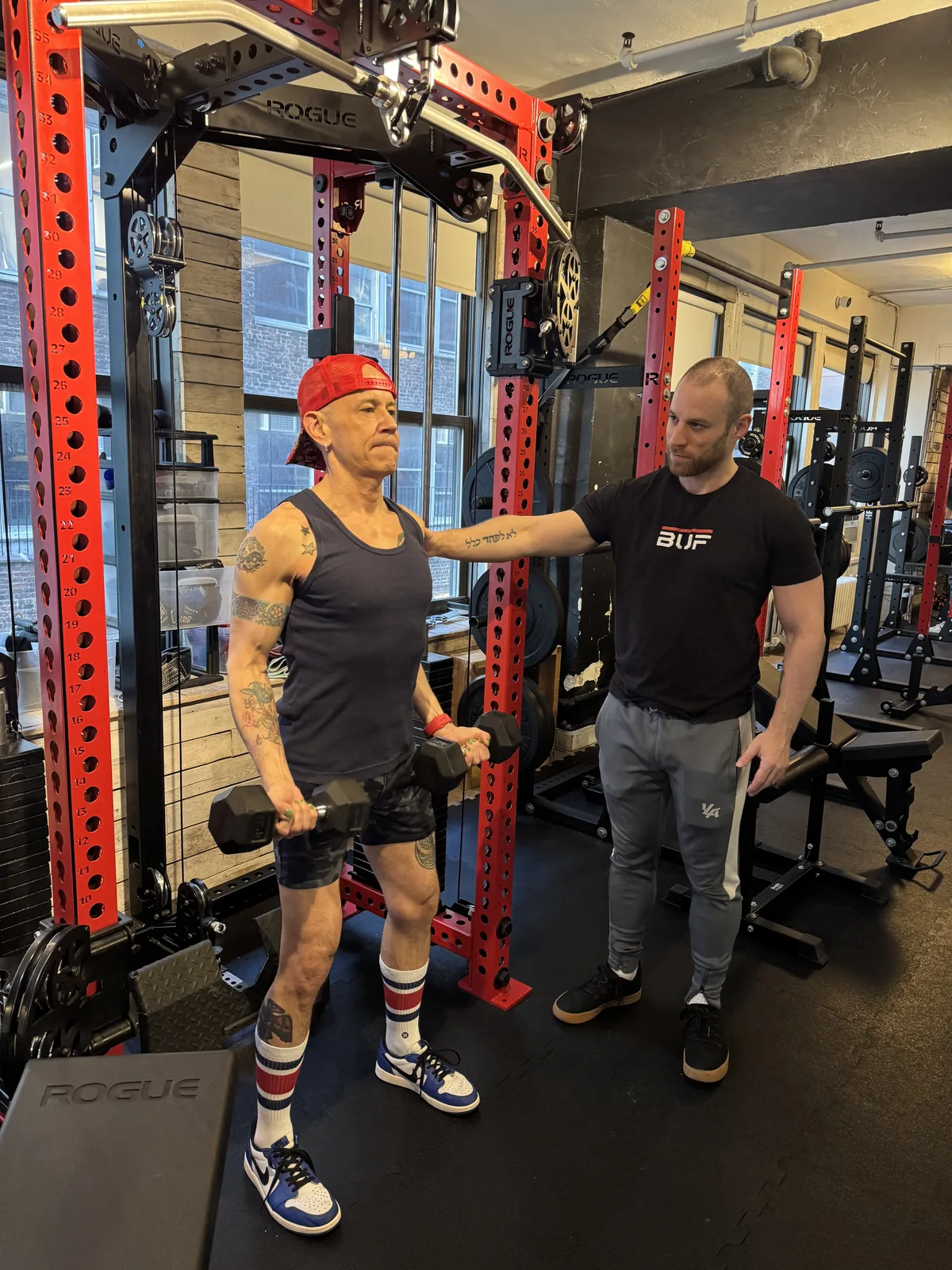
The short answer is two to three times per week. That's the recommendation we give 90% of our new clients at BUF Over 50, regardless of whether they're 51 or 78. But the better answer requires understanding why — and why the schedule that worked when you were 35 doesn't transfer cleanly to your 50s and beyond.
The science: why frequency matters more than session length
Muscle responds to a stimulus called muscle protein synthesis (MPS) — your body's process of rebuilding muscle tissue after exercise. For younger adults, a hard strength session elevates MPS for about 48 hours. After 50, that window shrinks to roughly 36 hours. After 65, it's closer to 24-30 hours.
What that means practically: if you only strength-train once a week, your muscles spend most of the week in a non-building state. Two sessions, spaced 3-4 days apart, keeps MPS elevated more days per week. Three sessions is even better, but with sharply diminishing returns past that point — and increased injury risk.
What "strength training" actually means for adults 50+
It does not mean machines for an hour while watching TV. The most effective programs for senior citizens and adults over 50 emphasize:
- Compound movements — exercises that move multiple joints at once. Squats, lunges, presses, rows, deadlifts. These give you the most return per minute in the gym.
- Progressive overload — slightly heavier weight, slightly more reps, or slightly cleaner form, week over week. Without progression, you maintain. With it, you build.
- Full range of motion — going through your available joint range, not just the easy middle. This is where mobility training meshes with strength.
- Sufficient intensity — the last 2-3 reps of each set should be hard. If you finish 12 reps feeling like you could have done 12 more, the load is too light.
Realistic schedules
If you're brand new to strength training (or returning after 5+ years away):
2 sessions per week, full-body, 45 minutes each. Days like Monday and Thursday, or Tuesday and Friday. Lighter loads, focus on movement quality. After 4-6 weeks, your nervous system and connective tissue have caught up and you can push harder.
If you've been training consistently for 6+ months:
3 sessions per week, full-body, 45-60 minutes each. Monday-Wednesday-Friday, or Tuesday-Thursday-Saturday. Mix of compound lifts (squats, presses, rows) and accessory work (single-joint exercises for arms, calves, core).
If you have health considerations or are recovering from an injury:
Many older adults benefit from 2 strength sessions plus 1-2 dedicated mobility sessions per week. The mobility work can be a useful complement to strength training, often easier on the body when starting out. Talk with your doctor first if you have a specific diagnosis — we are fitness professionals, not medical professionals.
Recovery: the part most people get wrong
Recovery is when adaptation happens. After 50, the things that matter most are:
Sleep. 7-9 hours, consistently. The biggest single variable in how strength gains accumulate after 50. Poor sleep blunts MPS, raises cortisol, and slows tissue repair. Clients who fix their sleep before fixing their training plan see better results than the reverse.
Protein. Aim for about 0.7-1.0 grams of protein per pound of body weight per day, spread across 3-4 meals. Older adults are less efficient at converting dietary protein into muscle (a phenomenon called anabolic resistance), so the total intake needs to be higher than for younger adults.
Active rest days. Walking, swimming, light cycling, gentle yoga on off days. Sitting still on rest days is worse for recovery than moving gently — circulation moves nutrients to recovering tissue.
Why even one session per week is worth doing
If you absolutely cannot fit two sessions in — once a week is still substantially better than zero. Adults who strength-train once a week maintain about 60-70% of the strength gains they would have from twice a week, and almost all of the bone density benefits. Don't let perfect be the enemy of good. Start with what's realistic for your schedule.
And don't skip strength training in favor of cardio thinking you'll "do strength later." Cardio is great for heart health, but it doesn't preserve muscle or bone. After 50, those two things — muscle and bone — are what determine whether you stay independent in your 70s and 80s.
When to bring in a trainer
The two most common signs you need professional coaching: (1) you've been training on your own for 3+ months and not getting stronger, or (2) you have pain or condition you don't know how to train around. A few sessions with a Certified Senior Fitness Specialist usually resolves both quickly.
At BUF Over 50 in Midtown Manhattan, our standard program for new senior citizens and adults 50+ is two 1-on-1 sessions per week, supplemented by 1-2 home days using simple equipment. We price every session under $100 and don't require contracts. Get in touch for a free consultation.